

 Site menu
 Chapter 19: King Prithu's One
Hundred Horse
Sacrifices
Chapter 19: King Prithu's One
Hundred Horse
Sacrifices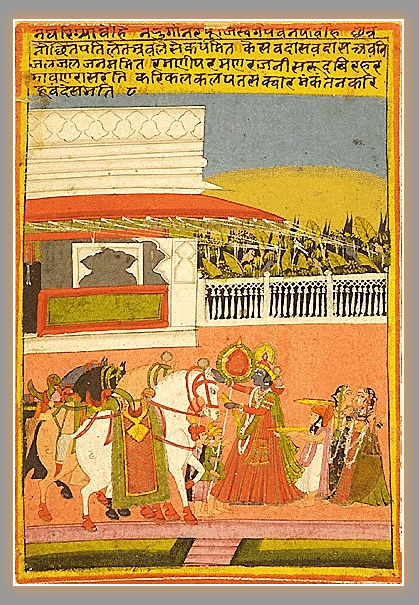 (1) The sage Maitreya said: 'Thereafter he, the
king, in the land of Manu known as Brahmâvarta, where the
Sarasvatî flows to the east, then initiated the
performance of a hundred horse sacrifices. (2)
Faced with this most powerful excel in fruitive action King Indra, who
himself had performed a hundred sacrifices, could not
tolerate
the great ceremonies of sacrifice of King Prithu. (3) It was there that directly the enjoyer of all
sacrifice, the
Supreme Lord Vishnu,
the
transcendental controller who is the proprietor, the teacher of all the world
and
everyone's
soul, would show
Himself. (4)
Together with Brahmâ and S'iva and all the local rulers
with their followers, He is praised by the inhabitants and singers of
heaven and the wise. (5) The perfected and the ones
rooted in learning, the descendants of Diti, the fruitive workers and
the guardians of wealth attended there headed by Nanda
and Sunanda, the most respectful
associates of the Lord. (6) All the great devotees who always serve
Him with diligence assembled there: the masters of yoga lead by
Sanaka [the Kumâras], Kapila, Nârada and Dattâtreya. (7) Dear son of Bharata, because of that meeting the land
fulfilled, alike
the cow that produces all the milk, all wishes by yielding as desired every
object that the sacrificer needed.
(8) The rivers carried all the water needed,
there
was milk, curd and the food of other dairy products and the trees with
their big bodies bore fruits and dripped with honey. (9) The people of all places along with their
governors brought forward presentations of the four kinds of foodstuff
[what is chewed, licked, sucked and drunk] and heaps of jewels from the
hills and oceans. (10) Thus
King
Prithu abiding by the Lord beyond the Senses, was
the most opulent person, but the great Lord Indra, being envious,
formed a hindrance. (11) Being that envious he unseen
stole the sacrificial animal when the son of Vena was performing the
last horse sacrifice meant to please the Lord of all Sacrifices. (12) Indra
impersonating as a
liberated soul and thus most confusingly presenting irreligion as
religion, was spotted by sage
Atri and then hurried away into
the sky. (13)
The son of King Prithu, a great hero,
encouraged by sage Atri to kill him, became very angry and shouted:
'Wait, just wait!' (14) But when he saw that he was wearing the dress
that is considered religious, had knotted hair and a body smeared all over with ashes, he could not release an arrow at him. (15)
My best one, the son of Prithu having
refrained
from
killing
was
by
sage
Atri
admonished
to
do
it
nevertheless
since the great Indra had sunken as low as to impede the performance of a yajña. (16)
Thus being ordered the son of Prithu, who
was as angry as the king of the vultures was with Râvana, began to
chase
Indra
who
hastily
moved
away
at
a
distance.
(17)
With him in pursuit, Indra vanished
abandoning the horse as well as his false dress. The
great hero then brought the
animal of his father back to the sacrificial arena.
(1) The sage Maitreya said: 'Thereafter he, the
king, in the land of Manu known as Brahmâvarta, where the
Sarasvatî flows to the east, then initiated the
performance of a hundred horse sacrifices. (2)
Faced with this most powerful excel in fruitive action King Indra, who
himself had performed a hundred sacrifices, could not
tolerate
the great ceremonies of sacrifice of King Prithu. (3) It was there that directly the enjoyer of all
sacrifice, the
Supreme Lord Vishnu,
the
transcendental controller who is the proprietor, the teacher of all the world
and
everyone's
soul, would show
Himself. (4)
Together with Brahmâ and S'iva and all the local rulers
with their followers, He is praised by the inhabitants and singers of
heaven and the wise. (5) The perfected and the ones
rooted in learning, the descendants of Diti, the fruitive workers and
the guardians of wealth attended there headed by Nanda
and Sunanda, the most respectful
associates of the Lord. (6) All the great devotees who always serve
Him with diligence assembled there: the masters of yoga lead by
Sanaka [the Kumâras], Kapila, Nârada and Dattâtreya. (7) Dear son of Bharata, because of that meeting the land
fulfilled, alike
the cow that produces all the milk, all wishes by yielding as desired every
object that the sacrificer needed.
(8) The rivers carried all the water needed,
there
was milk, curd and the food of other dairy products and the trees with
their big bodies bore fruits and dripped with honey. (9) The people of all places along with their
governors brought forward presentations of the four kinds of foodstuff
[what is chewed, licked, sucked and drunk] and heaps of jewels from the
hills and oceans. (10) Thus
King
Prithu abiding by the Lord beyond the Senses, was
the most opulent person, but the great Lord Indra, being envious,
formed a hindrance. (11) Being that envious he unseen
stole the sacrificial animal when the son of Vena was performing the
last horse sacrifice meant to please the Lord of all Sacrifices. (12) Indra
impersonating as a
liberated soul and thus most confusingly presenting irreligion as
religion, was spotted by sage
Atri and then hurried away into
the sky. (13)
The son of King Prithu, a great hero,
encouraged by sage Atri to kill him, became very angry and shouted:
'Wait, just wait!' (14) But when he saw that he was wearing the dress
that is considered religious, had knotted hair and a body smeared all over with ashes, he could not release an arrow at him. (15)
My best one, the son of Prithu having
refrained
from
killing
was
by
sage
Atri
admonished
to
do
it
nevertheless
since the great Indra had sunken as low as to impede the performance of a yajña. (16)
Thus being ordered the son of Prithu, who
was as angry as the king of the vultures was with Râvana, began to
chase
Indra
who
hastily
moved
away
at
a
distance.
(17)
With him in pursuit, Indra vanished
abandoning the horse as well as his false dress. The
great hero then brought the
animal of his father back to the sacrificial arena.(18) O master [Vidura], seeing the reality of his wonderful action the great sages honored him accordingly with the name Vijitâs'va [he who won the horse]. (19) But not seen under the cover of a dense darkness he had created, the mighty King Indra again took the horse away from the sacrificial block where it was chained in golden shackles. (20) When Atri pointed out that he hurried away in the open, the hero this time seeing him holding a staff with a skull at the top, [again] couldn't manage to kill him. (21) With Atri admonishing him to go after him he in anger had fixed an arrow but the independent Indra who gave up the horse and the apparel [for the second time], kept himself out of reach. (22) The hero then took the horse and went back to the sacrificial arena of his father. Ever since those with a poor fund of knowledge adopt that false show of the lord of heaven. (23) Those forms that Indra assumed with the desire to steal the horse are all sign and symbol of sinful activities. For this the word deficient is used [with khanda or deficient one speaks of pâkhanda or pâshanda, the false preacher or heretic]. (24-25) With Indra who in his desire to stop the sacrifice stole away the horse from the son of Vena and thus adopted and abandoned the religious garb, the common man foolishly enough got attracted to this falsehood of faith in red robes, going naked etc. because it is generally done with great cunning and a good command of speech. (26) The incarnation of the Lord, King Prithu celebrated as the all-powerful one, understood this and very angry with Indra took an arrow and lifted his bow.
(27) The priests who saw that Prithu thus prepared to kill the king of heaven, couldn't tolerate the leap of mind of his terrifying display of power and objected: 'O great soul, as it is said in the scriptures, it is not proper to kill others in matters like these. (28) Indra, your enemy who in fact already lost his power as the destroyer of your interest, we will summon with mantras never used before and forthwith by force sacrifice him in the fire o King.'
(29) After thus having advised the leader of the ceremony o Vidura, the priests grim-faced with the sacrificial ladle in their hand stood prepared to perform the sacrifice, but when they were about to begin Lord Brahmâ asked them to stop: (30) 'Indra shouldn't be killed by you, for he whose end you wish is also the offering himself, he is an integral part of the Supreme Lord. And so also the ones of God you wish to please by the sacrificing are all part of Indra! (31) And then o twice-born ones, beware of this great violation of dharma committed by Indra in his desire to impede these proceedings of the king. (32) Let it be so that from the side of the widely renown King Prithu there are the ninety-nine sacrifices he performed. There is no use [o King] for more correctly performed sacrifices, for you know the path of liberation very well. (33) You surely shouldn't act in anger against Lord Indra, it suffers no doubt that it will be to the good fortune of the both of you to stand together for the multiformity of the Lord celebrated in the scriptures. (34) O great King please listen to what I tell you with the greatest esteem: do not as you did, get into the mind of anger because of a twist of fate, because from the king who is of such a consideration one will enter the darkest regions. (35) Let this sacrificing end, it was by what Indra has created that among the ones of God so many principles of religion were violated and bad habits rooted. (36) Just see how Indra as the one who broke your sacrifice with stealing the horse, introduced this deception that is so alluring to the common man that he is carried away by it. (37) Your Majesty, you incarnated according to time and circumstance in this world in order to deliver us, for the system of religion that by the misdeeds of King Vena almost had vanished. And now you are there as a part and parcel of the body of Vishnu, o son of Vena. (38) Therefore, in consideration of the welfare of the world o protector of the people, answer to the determination of the progenitors of this earth [to respect you as an expansion of the Supreme One] and foil the illusion that was created by Indra in the form of the moralizing without servitude [the pseudo religion, the hypocrisy] that is the mother of the dangerous path of heresy.'
(39) Maitreya continued: 'Thus being advised by the teacher of all Prithu, the king and master, acted according to what was told and concluded, moved to sympathy, to peace with Indra. (40) After having done so he took a customary bath and received for his glorious actions the blessings of the God-conscious whom he had pleased with the performance of his sacrifices. (41) When all the men of learning had offered the original king their blessings, they were most contented with the great respect and rewards they received from him o royal one [and said]: (42) 'O mighty-armed one, we, the forefathers, gods, sages and also common people have all assembled because you invited us and now feel very honored by your gifts and expressions of respect.'
